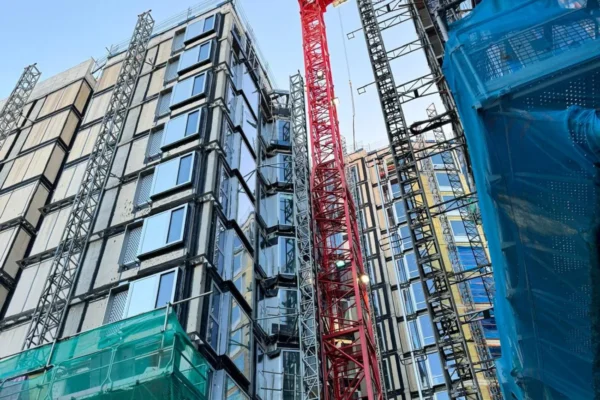
Cost certainty in façade procurement is – more often than not – won or lost at the points where design responsibility, supply assumptions and installation interfaces meet. On paper, a façade cost plan may separate glazing, SFS (Steel Framing System), rainscreen cladding, membranes, louvres, flashings and fire-stopping into tidy packages, but a building envelope is designed and installed as a connected system. When an opening is moved, a support detail changes or panel depth is revised, the consequences can run through fixing loads, tolerances, weathering lines, insulation continuity, access requirements and sequencing.
That is why single-source façade solutions can improve your cost certainty. This isn’t simply that ‘one package is tidier to administer’, but that connected façade decisions are usually priced through one accountable scope before their consequences emerge as variations, exclusions or disputed interface costs. Let’s look at this issue in some more depth.
A single-source approach does not remove every risk or guarantee a fixed final cost. Its effectiveness still depends on having a clearly defined scope, coordinated design information, transparent tender assumptions and an effective change-control process. However, bringing connected façade elements under one scope can make interfaces more visible and allow their cost consequences to be assessed earlier.
Package Gaps Can Push Up Façade Costs
The UK Government’s Construction Playbook emphasises that risk allocation should be carefully considered before procurement and that risks should be managed by the organisations best placed to control and absorb them. This principle is particularly relevant to façade procurement, where additional costs frequently arise at the boundaries between different design and installation packages.
For instance, a façade glazing solution may be priced correctly against its own drawings, while the neighbouring cladding, framing or fire-stopping package has allowed for a different condition at the same junction. Each return can look reasonable on its own, but a gap becomes visible when the detail has to be built – creating cost uncertainty. The result can be a variation, redesign cost or final-account argument because the extra work was not clearly included in either package. A coordinated façade package can reduce that risk by identifying and pricing connected envelope details within a clearly defined commercial scope.
Design Development Can Create Variable Costs
Façade design often continues after tender, as supplier calculations may refine fixing loads, system approvals may affect profile depth, and glass weights can change the handling and support detail before manufacture. These changes are a key part of turning a tender design into a buildable envelope, but the tender does need to show which package has priced the work needed to deal with them.
If design development is split across several packages, a technical revision can create costs in more than one place. For instance, a revised fixing detail may start with the frame, but it can also change the local support and the way the unit is installed; if warranty or approval information has to be updated as a result, that work needs to be included somewhere in the price. Under a single-source package, these knock-on requirements are priced and managed within the façade solutions scope instead of being qualified separately by each affected trade.
Substitutions Can Shift The Cost Into The Installed Detail
A façade substitution is not a like-for-like saving unless the installed detail stays the same. A lower-cost glazing unit, panel or framing component may need different brackets, gasket positions, sealants, packers or fixing centres. It may also change the lead-in period if the alternative product has a different manufacturing route or needs fresh supplier approval before it can be used.
To avoid this, the tender check should follow the substitution through the façade, rather than stopping at the product line. If the alternative glass is heavier, the handling method and frame support may change, and if the panel depth changes, the weathering line, flashings or interface with adjoining cladding may need to be redrawn. If a membrane, sealant or framing component changes, the warranty position and compatibility evidence may need to be confirmed again.
This is where single-source façade solutions give your QS team a cleaner comparison. With split packages, the saving can appear in one return while extra costs come back later through revised drawings, installation qualifications, approval checks or changes to the adjoining façade package. Where the connected elements sit within the same scope, the contractor proposing the change can assess its effect on the surrounding detail as well as the substituted product itself.
Find Out More
To find out more about single-source façade solutions, please contact the team at Advanced Glass today by clicking here or call us directly on 01455241844.